Global layout
 +86 769 2366 8529




Time:2026-04-15 Views:52
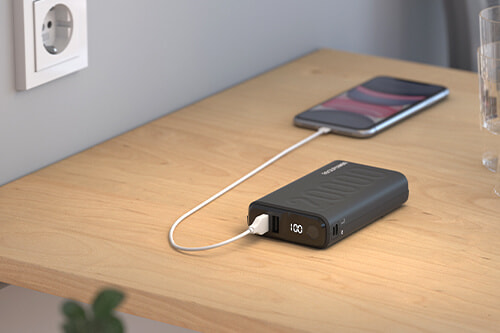
In today's highly mobile and intelligent digital era, electricity has become one of the most fundamental and critical resources in both daily life and work. The widespread use of smartphones, tablets, wireless earbuds, smartwatches, portable computers, and various smart devices has significantly increased people’s dependence on continuous and stable power supply. Against this backdrop, the **Portable Battery Power Bank** has emerged as an essential and highly efficient energy storage and supply device, becoming a core tool in modern digital life.
At its core, a portable power bank is a reusable energy storage system based on high-energy-density lithium battery technology. It can provide stable power to electronic devices in environments without access to electricity and can also recharge itself when connected to a power source, enabling a bidirectional energy cycle of “storage + output.” This flexible energy supply method makes it widely applicable in daily life, business travel, outdoor activities, and emergency backup scenarios.
Modern Portable Battery Power Banks typically use lithium-ion or lithium-polymer batteries as their core energy storage units. Compared with traditional battery technologies, lithium systems offer higher energy density, lighter weight, longer cycle life, and better charging efficiency, allowing compact devices to deliver strong endurance. These technological advancements have greatly improved user experience and driven the continuous evolution and adoption of portable energy solutions.
Structurally, a portable power bank consists of battery cells, a battery management system (BMS/PMIC), boost conversion circuits, and multi-functional input/output interfaces. The outer shell is usually made of flame-retardant PC+ABS composite materials or aerospace-grade aluminum alloy, providing excellent impact resistance, heat dissipation, and durability, ensuring stable and safe operation under long-term high-load conditions.
The Battery Management System (BMS) serves as the “intelligent brain” of the Portable Battery Power Bank. It continuously monitors voltage, current, temperature, and remaining capacity, while dynamically managing charging and discharging processes. Through multiple protection mechanisms such as overcharge protection, over-discharge protection, overcurrent protection, short-circuit protection, and temperature control protection, it effectively prevents battery anomalies and ensures safe and stable operation.
In terms of performance, modern power banks widely support multiple fast-charging protocols, including PD (Power Delivery), QC (Quick Charge), PPS, and SCP. This enables users to rapidly charge smartphones, tablets, wireless earbuds, and even lightweight laptops, significantly reducing waiting time and improving efficiency. Some high-end models even support ultra-high power output to meet the demands of more energy-intensive devices.
Capacity options for Portable Battery Power Banks range from 5,000mAh to over 30,000mAh. Smaller capacities are ideal for daily lightweight use, while larger capacities are suitable for long-distance travel, outdoor work, photography, and multi-device charging scenarios. Through optimized design balancing size and capacity, modern power banks achieve the best compromise between portability and endurance.
In terms of interface configuration, most modern devices are equipped with USB-A, USB-C, and Micro USB ports, with USB-C becoming the dominant standard. Some advanced models also support bidirectional fast charging, allowing both input and output to operate at high power levels. Multi-port output designs enable simultaneous charging of multiple devices, meeting diverse usage needs.
Safety remains a core priority in portable power bank design. High-quality products integrate multiple protection systems, including thermal protection, overvoltage protection, overcurrent protection, short-circuit protection, and cell balancing management systems. Intelligent chips continuously adjust output power to prevent overheating and overload, ensuring safe usage in various environments.
From a design perspective, power banks are evolving toward lightweight structures, high-power output, and smart functionality. Ultra-thin designs enhance portability, digital displays provide real-time battery status, and some models integrate wireless charging for added convenience. Foldable plug designs also improve usability for travel and daily use.
In terms of applications, Portable Battery Power Banks cover nearly all mobile power needs. For business professionals, they serve as essential energy support during meetings and travel. For students, they provide stable power for study and entertainment. For outdoor enthusiasts, they are critical energy sources for camping, hiking, and travel. In emergencies, they can function as backup power supplies for communication devices, ensuring uninterrupted connectivity.
As smart device ecosystems continue to expand, power management requirements are becoming increasingly complex. Charging multiple devices simultaneously or powering both communication and photography equipment in outdoor environments demands higher performance. As a result, smart power distribution technology has become a key industry trend, enabling automatic output adjustment based on device requirements for higher efficiency.
From an environmental perspective, modern power banks use long-life battery cells and optimized energy conversion systems to reduce energy loss. Their reusable nature significantly reduces electronic waste, aligning with sustainable consumption practices. Many brands are incorporating eco-friendly materials and energy-efficient technologies into product design.
From a user experience standpoint, Portable Battery Power Banks emphasize not only performance but also usability. Clean and modern aesthetics, comfortable handling, clear battery indicators, and stable output all contribute to their core competitiveness. Some products also integrate app-based smart management systems, allowing users to monitor battery health, charging history, and usage data in real time for more precise energy control.
In conclusion, the **Portable Battery Power Bank**, as a vital component of modern mobile energy systems, integrates high-energy-density battery technology, intelligent power management systems, multi-protocol fast charging, and comprehensive safety protection. It not only extends device runtime but also significantly enhances mobility and convenience. By addressing modern “battery anxiety,” it has become an essential energy bridge between users and smart devices and a key direction for the future of portable energy solutions.
Be the first to receive our latest news, how-to user guides,
and exclusive deals! Subscribe now.

 Headquarter Address:10F, Building 25, N0. 179 Fengguan, Dongshen Road, Dongguan, Guangdong
 Factory Address:Building 3, Area D, Shengyang Science and Technology Industrial Park, East District of Suichuan County Industrial Park, Ji'an, Jiangxi
 Headquarter Telephone No.:+86 769 2366 8529
Factory Telephone No.:+86 796 6111618
 Contact Person:Kevin Chen
 Email Address:chen@xpower-world.com