Global layout
 +86 769 2366 8529




Time:2026-04-17 Views:65
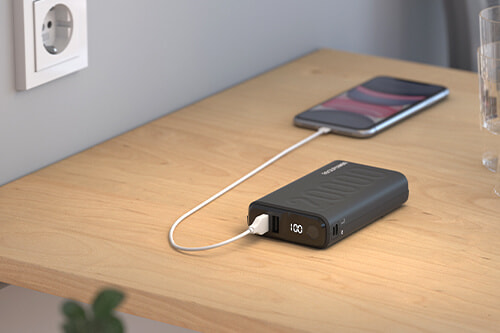
Solar charging power banks have gained popularity among outdoor enthusiasts due to their promise of "energy independence"—the ability to recharge using sunlight without relying on electrical outlets. However, their practicality in real-world scenarios is often overestimated, as their performance is limited by multiple factors, including solar panel efficiency, environmental conditions, and battery capacity. While solar charging can be a useful emergency backup, it is far from a replacement for traditional wall charging, especially in daily or non-outdoor settings.
The core limitation of solar charging power banks lies in the efficiency of their built-in photovoltaic panels. Most consumer-grade solar power banks are equipped with small solar panels, typically with a power output of 3W to 10W. Even under ideal conditions—direct sunlight at peak intensity (around 1000W/m²)—a 10W solar panel can only generate about 6 to 7 watt-hours per hour. In reality, factors such as cloud cover, dust, dew, and the angle of sunlight significantly reduce the actual output, often to half or less of the nominal power. For example, a 20,000mAh (74Wh) solar power bank would require more than 15 hours of continuous full sunlight to fully charge, which is rarely achievable during a typical day of hiking or camping, especially in regions with limited sunlight or frequent cloud cover.
Another key factor affecting practicality is the purpose of solar charging. Solar power banks are not designed to replace wall charging but to provide emergency power in off-grid environments. For instance, during a multi-day camping trip, if the power bank’s battery is depleted, placing it in sunlight for 6 to 8 hours can provide enough power to charge a smartphone to 15% to 20%, which is sufficient for making emergency calls or using GPS. However, for daily use, solar charging is too slow and unreliable compared to wall charging, which can fully charge a power bank in 2 to 3 hours. Additionally, solar power banks are often heavier and bulkier than standard power banks due to the added solar panels, making them less portable for daily commuting. In summary, solar charging power banks are practical for outdoor enthusiasts, field workers, or those in areas with unstable power supply, but they are not a practical choice for daily use where wall charging is accessible.
Be the first to receive our latest news, how-to user guides,
and exclusive deals! Subscribe now.

 Headquarter Address:10F, Building 25, N0. 179 Fengguan, Dongshen Road, Dongguan, Guangdong
 Factory Address:Building 3, Area D, Shengyang Science and Technology Industrial Park, East District of Suichuan County Industrial Park, Ji'an, Jiangxi
 Headquarter Telephone No.:+86 769 2366 8529
Factory Telephone No.:+86 796 6111618
 Contact Person:Kevin Chen
 Email Address:chen@xpower-world.com