Global layout
 +86 769 2366 8529




Time:2026-05-12 Views:64
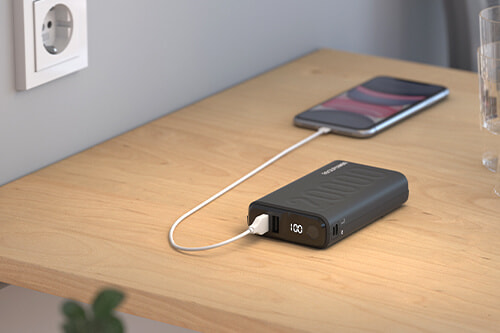
In the era of rapid technological advancement, the smart fast charging protocol has become a core feature of power banks, directly determining charging efficiency, compatibility, and user experience. A high-quality power bank is not just a simple energy storage device but also a smart charging hub that supports multiple mainstream fast charging protocols to adapt to different electronic devices such as smartphones, tablets, laptops, and earbuds. The most common fast charging protocols supported by modern power banks include USB Power Delivery (PD), Quick Charge (QC), Adaptive Fast Charging (AFC), Super Charge (SCP), and Power Delivery 3.0/4.0, each with its own characteristics and applicable scenarios.
USB Power Delivery (PD) is a universal fast charging protocol developed by the USB Implementers Forum (USB-IF), which supports bidirectional charging and a wide range of voltage and current adjustments, making it compatible with most modern devices, including iPhones, iPads, and laptops. For example, a power bank supporting PD 3.0 can provide up to 65W of power, enabling fast charging for thin and light laptops, while also charging iPhones at 20W, significantly reducing charging time compared to traditional 5W charging. Quick Charge (QC), developed by Qualcomm, is widely used in Android smartphones, supporting voltages of 5V, 9V, 12V, and even 20V, with charging power ranging from 18W to 65W, allowing Android devices to be fully charged in about an hour. In addition, protocols such as AFC (Samsung’s proprietary fast charging protocol), SCP (Huawei’s fast charging protocol), and VOOC (Oppo’s fast charging protocol) are also commonly supported, ensuring that the power bank can achieve fast charging for specific brand devices without compatibility issues.
The support of smart fast charging protocols is not only reflected in the variety of protocols but also in the intelligence of charging. High-end power banks are equipped with intelligent protocol identification chips, which can automatically detect the connected device’s charging protocol and adjust the output voltage and current accordingly to avoid overcharging, overheating, or damage to the device. For example, when a power bank is connected to a smartphone that supports QC 3.0, it will automatically switch to the QC protocol and output the corresponding voltage and current; when connected to a device that does not support fast charging, it will switch to the standard 5V/2A charging mode to ensure charging safety. This intelligent adaptation not only improves charging efficiency but also protects the battery life of both the power bank and the connected device, making it a key factor for users to choose a power bank.
Be the first to receive our latest news, how-to user guides,
and exclusive deals! Subscribe now.

 Headquarter Address:10F, Building 25, N0. 179 Fengguan, Dongshen Road, Dongguan, Guangdong
 Factory Address:Building 3, Area D, Shengyang Science and Technology Industrial Park, East District of Suichuan County Industrial Park, Ji'an, Jiangxi
 Headquarter Telephone No.:+86 769 2366 8529
Factory Telephone No.:+86 796 6111618
 Contact Person:Kevin Chen
 Email Address:chen@xpower-world.com