Global layout
 +86 769 2366 8529




Time:2026-05-12 Views:36
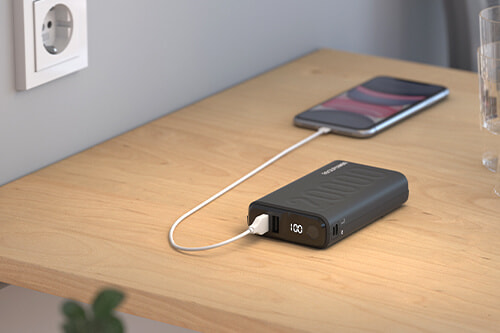
Proper maintenance and care are crucial to ensuring the safe use of the power bank and extending its service life. Many users ignore the maintenance of power banks, leading to problems such as reduced battery capacity, shortened service life, and even safety hazards. Therefore, it is necessary to master the correct maintenance and care methods to maximize the performance and service life of the power bank. The first and most important note is to avoid extreme environmental conditions, as power bank batteries (usually lithium-ion batteries) are very sensitive to temperature, humidity, and direct sunlight.
In terms of temperature, the power bank should be stored and used in an environment with a temperature between 0℃ and 45℃. Avoid placing it in high-temperature environments such as direct sunlight, near a heater, or in a closed car in summer, as high temperatures will accelerate the aging of the battery, reduce its capacity, and even cause the battery to swell or leak. Similarly, avoid using or storing the power bank in low-temperature environments (below 0℃), as low temperatures will affect the battery’s charging and discharging performance, and may even cause permanent damage to the battery. In terms of humidity, the power bank should be kept in a dry and well-ventilated environment, avoiding contact with water or damp places (such as bathrooms, kitchens, or rainy days), as moisture can cause short circuits in the internal circuit of the power bank, leading to malfunctions or safety hazards.
Another important maintenance note is to use the original or compatible charging accessories. Using inferior charging cables, chargers, or adapters that do not match the power bank’s specifications can not only affect charging efficiency but also damage the power bank’s internal circuit and battery. For example, using a charger with excessive voltage or current may cause overcharging of the power bank, leading to battery swelling or damage; using a damaged or inferior charging cable may cause poor contact, short circuits, or even overheating. In addition, it is necessary to regularly clean the charging ports of the power bank and the connected devices to remove dust, debris, or oxidation, which can avoid poor contact and ensure smooth charging. It is recommended to use a soft cotton swab or a small brush to clean the ports, and do not use sharp objects to pick the ports to avoid damaging the internal pins.
Finally, avoid overcharging or over-discharging the power bank. Do not leave the power bank charging for a long time (such as overnight) after it is fully charged, as overcharging will accelerate battery aging and reduce its service life. Similarly, do not use the power bank until it is completely drained of power, as over-discharging will damage the battery’s internal structure and cause irreversible damage. It is recommended to charge the power bank when its remaining power is between 20% and 30%, and stop charging once it is fully charged (most power banks have an automatic power-off function after full charge, but it is still not recommended to leave it plugged in for a long time).
Be the first to receive our latest news, how-to user guides,
and exclusive deals! Subscribe now.

 Headquarter Address:10F, Building 25, N0. 179 Fengguan, Dongshen Road, Dongguan, Guangdong
 Factory Address:Building 3, Area D, Shengyang Science and Technology Industrial Park, East District of Suichuan County Industrial Park, Ji'an, Jiangxi
 Headquarter Telephone No.:+86 769 2366 8529
Factory Telephone No.:+86 796 6111618
 Contact Person:Kevin Chen
 Email Address:chen@xpower-world.com