Global layout
 +86 769 2366 8529




Time:2026-05-12 Views:66
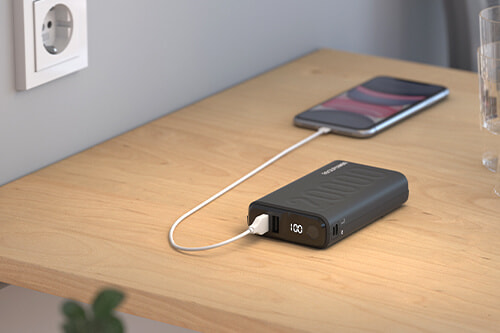
The fault self-test function is an essential safety feature of modern power banks, designed to automatically detect potential malfunctions during use, alert users in a timely manner, and prevent safety hazards such as overheating, short circuits, and battery leakage. This function is realized through the built-in intelligent control chip and various sensors (such as temperature sensors, current sensors, and voltage sensors) in the power bank, which continuously monitor the working status of the power bank, including battery voltage, charging/discharging current, internal temperature, and circuit connection status, and conduct real-time self-inspection to identify abnormal conditions.
The fault self-test function covers a variety of common malfunctions, including battery overcharge, over-discharge, over-current, over-temperature, short circuit, and poor contact. When the power bank detects an abnormal condition, it will take corresponding protective measures immediately, such as cutting off the charging/discharging circuit, reducing output power, or activating the alarm function to remind users of the fault. For example, if the internal temperature of the power bank exceeds the safe range (usually 60℃) during charging or discharging, the temperature sensor will send a signal to the control chip, which will then cut off the circuit to prevent the battery from overheating and causing combustion or explosion. If there is a short circuit in the charging cable or the connected device, the current sensor will detect an excessive current, and the power bank will immediately stop outputting power to avoid damage to the power bank and the connected device.
In addition to automatic fault detection and protection, many power banks also have a manual self-test function, which allows users to actively check the working status of the power bank by pressing a specific button (usually the power button) for a certain period of time. After activating the manual self-test, the power bank’s indicator lights will flash in a specific pattern to indicate whether each part is working normally. For example, if all indicator lights flash sequentially, it means the power bank is working normally; if a certain indicator light flashes continuously, it indicates a fault in the corresponding part (such as battery damage or circuit failure). This manual self-test function allows users to check the power bank’s status regularly, find potential faults in advance, and avoid sudden failures during use, ensuring the safety and reliability of the power bank.
Be the first to receive our latest news, how-to user guides,
and exclusive deals! Subscribe now.

 Headquarter Address:10F, Building 25, N0. 179 Fengguan, Dongshen Road, Dongguan, Guangdong
 Factory Address:Building 3, Area D, Shengyang Science and Technology Industrial Park, East District of Suichuan County Industrial Park, Ji'an, Jiangxi
 Headquarter Telephone No.:+86 769 2366 8529
Factory Telephone No.:+86 796 6111618
 Contact Person:Kevin Chen
 Email Address:chen@xpower-world.com