Global layout
 +86 769 2366 8529




Time:2026-05-14 Views:103
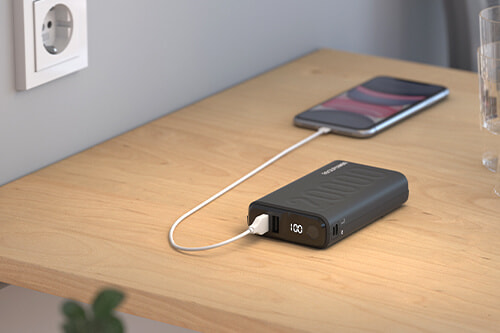
Overload protection is another important safety protection function of power banks, which is used to prevent the power bank from being damaged due to excessive load during the discharging process. Overload usually occurs when the total power of the external devices connected to the power bank exceeds the maximum output power of the power bank, or when a single device requires a current that exceeds the maximum output current of the power bank. For example, connecting multiple high-power devices (such as tablets, laptops, and speakers) to a power bank with low output power at the same time may cause overload. The overload protection capability test is to verify whether the power bank can quickly and stably trigger the protection mechanism under overload conditions, so as to protect the internal circuit and battery of the power bank.
The overload protection capability test mainly includes testing the overload trigger threshold, response time, and recovery performance. The overload trigger threshold refers to the maximum load power or current that the power bank can bear. When the load exceeds this threshold, the overload protection mechanism should be triggered. The trigger threshold of qualified power banks is usually set at 110% to 120% of the rated output power, which can not only avoid false triggering under normal load conditions but also effectively protect the power bank when overload occurs. The response time refers to the time it takes for the power bank to trigger overload protection after the load exceeds the threshold. Similar to short circuit protection, the faster the response time, the better the protection effect, and the response time of general qualified power banks is within 20ms.
The recovery performance test refers to whether the power bank can automatically recover to normal output after the overload condition is eliminated. For example, after the power bank triggers overload protection due to connecting too many devices, when some devices are disconnected and the load returns to the normal range, the power bank should be able to resume power supply to the remaining devices. In addition, during the overload protection test, testers also need to monitor the temperature, voltage, and current changes of the power bank to ensure that the power bank does not have overheating, voltage instability, or component damage during the overload process. A power bank with strong overload protection capability can not only ensure its own safety and service life but also protect the connected external devices from damage caused by unstable voltage or current due to overload.
Be the first to receive our latest news, how-to user guides,
and exclusive deals! Subscribe now.

 Headquarter Address:10F, Building 25, N0. 179 Fengguan, Dongshen Road, Dongguan, Guangdong
 Factory Address:Building 3, Area D, Shengyang Science and Technology Industrial Park, East District of Suichuan County Industrial Park, Ji'an, Jiangxi
 Headquarter Telephone No.:+86 769 2366 8529
Factory Telephone No.:+86 796 6111618
 Contact Person:Kevin Chen
 Email Address:chen@xpower-world.com