Global layout
 +86 769 2366 8529




Time:2026-09-21 Views:96
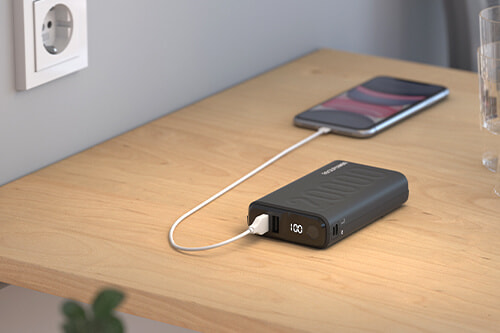
As one of the most popular portable energy storage devices in consumer electronics, the 20000mAh power bank balances large-capacity endurance and portability, and is widely used in daily travel, outdoor operations, mobile office and other scenarios. In high-frequency fast charging, simultaneous charging and discharging, and long-term load operation scenarios, heat generation is a core indicator that determines the performance, process quality and safety level of power banks. Compared with small-capacity power banks, the 20000mAh model features more battery cells, higher energy density and greater fast-charging power, resulting in larger overall working heat. Poor temperature control design will easily cause local heat accumulation, high temperature overheating and speed reduction. In severe cases, it will trigger cell aging, bulging and even potential safety hazards. From the perspective of heat generation technology, this paper systematically analyzes the heat sources, operating heat rules, temperature control and heat dissipation design, high-temperature hazards and optimization mechanisms of 20000mAh power banks, and fully expounds the technical logic and practical safety value of thermal management for large-capacity portable power supplies.
The core heat sources of a 20000mAh power bank are mainly divided into three categories: cell internal resistance heat, circuit board power loss heat, and fast charging protocol switching heat. First of all, internal resistance thermal loss is the fundamental heat source. During charging and discharging, lithium ions migrate inside the battery cells and produce inherent resistance. Higher current leads to more severe internal polarization and obvious heat generation. Equipped with multiple parallel cells, the 20000mAh power bank generates increased loop current under high-power fast charging, intensifies cell polarization and produces basic working heat. Secondly, heat is generated by PCB power loss. Fast charging chips, step-up and step-down modules and MOS tubes convert and adjust voltage and current, and electric energy loss is continuously converted into heat. Under high-power working conditions, the load of electronic components increases and the temperature rises significantly. Thirdly, dynamic switching of fast charging protocols causes instantaneous heat accumulation. When adapting to fast charging protocols of different digital devices, the power bank frequently adjusts voltage and current parameters, and instantaneous load fluctuation causes short-term concentrated heat generation.
20000mAh power banks show differentiated heat generation rules under different working conditions, which conform to most daily usage scenarios. Under conventional 5V slow charging conditions, the output current is stable with extremely low power loss, resulting in slight and normal warm temperature rise. Under high-power fast charging modes of 18W, 22.5W and 30W, the charge-discharge rate increases significantly, the load of cells and circuit boards rises sharply, and the temperature rises rapidly with concentrated heat on the middle frame and interface area, which is a normal physical characteristic of large-capacity fast-charging power banks. Simultaneous charging and discharging is the highest heat scenario. The power bank performs input charging and output discharging at the same time, and the superposition of dual-circuit heat leads to the peak operating temperature. In addition, ambient temperature affects heat dissipation. High temperature environment, closed placement and covering will block heat dissipation, cause heat accumulation and obvious overheating.
High-quality standard 20000mAh power banks are equipped with mature thermal management systems to suppress heat generation and accelerate heat dissipation through multi-dimensional design. In terms of hardware temperature control, built-in high-precision NTC thermistors monitor the real-time temperature of cells and circuit boards. Once the temperature reaches the preset threshold, the system automatically triggers temperature protection, reduces fast-charging power and limits output current to relieve heat accumulation, and cuts off power under extreme high temperature to eliminate hidden dangers. In terms of structural heat dissipation, premium models adopt hollow heat dissipation structures and high thermal conductivity insulating patches to quickly conduct accumulated heat. The body shell is made of flame-retardant, heat-conductive and high-temperature resistant materials to balance protection and heat dissipation. In terms of circuit optimization, low-internal-resistance cells and high-efficiency voltage stabilization chips reduce power loss and heat generation fundamentally, realizing dual effects of heat suppression and rapid dissipation.
Identifying abnormal heat generation and avoiding related hazards is the key to safe use of 20000mAh power banks. Normal working heat features uniform temperature and gentle temperature rise, and the device cools down rapidly after load removal without any damage. In contrast, abnormal heat is caused by equipment failure, irregular use and inferior craftsmanship, manifested as local overheating, rapid temperature rise and continuous heat generation after shutdown. Long-term high temperature accumulation accelerates the aging of battery electrolyte, increases internal resistance, causes capacity attenuation and endurance shrinkage, and greatly shortens battery service life. High temperature also damages circuit board components, leading to fast charging failure, unstable voltage and interface faults. More seriously, sustained high temperature destroys the internal battery structure, causes cell bulging and liquid leakage, and greatly increases the risk of short circuit and spontaneous combustion, requiring timely inspection and shutdown.
Compared with small-capacity power banks, 20000mAh large-capacity products have higher thermal management difficulty but sufficient temperature control redundancy. Small-capacity models have low power and insignificant heat generation but cannot support high-power fast charging and long-endurance power supply. With mature multi-channel temperature control, balanced heat dissipation and intelligent current limiting technology, standard 20000mAh power banks perfectly balance high-speed fast charging and heat control, maintaining the working temperature within a safe range. Meanwhile, the standardized cell arrangement ensures balanced load of each cell, avoids overload heat accumulation of single cells and eliminates local overheating risks, delivering far better thermal stability than inferior large-capacity power banks.
Scientific heat dissipation habits in daily use can effectively reduce the operating temperature and extend the service life of 20000mAh power banks. Users should avoid closed covering and blockage during use to maintain ventilation and heat dissipation, reduce high-load working modes such as long-term simultaneous charging and discharging, and stop operation for cooling after continuous high-power fast charging in high-temperature environments. Irregular operations such as inferior modification and non-original adapter matching should be prohibited to avoid abnormal circuit heat generation. With comprehensive thermal management mechanism and controllable working heat characteristics, regular 20000mAh power banks provide safe, stable and long-lasting mobile power supply, serving as an essential accessory for daily digital device endurance guarantee.
Be the first to receive our latest news, how-to user guides,
and exclusive deals! Subscribe now.

 Headquarter Address:10F, Building 25, N0. 179 Fengguan, Dongshen Road, Dongguan, Guangdong
 Factory Address:Building 3, Area D, Shengyang Science and Technology Industrial Park, East District of Suichuan County Industrial Park, Ji'an, Jiangxi
 Headquarter Telephone No.:+86 769 2366 8529
Factory Telephone No.:+86 796 6111618
 Contact Person:Kevin Chen
 Email Address:chen@xpower-world.com