Global layout
 +86 769 2366 8529




Time:2026-09-17 Views:143
As the core energy storage unit of golf cart power systems, the 48V golf cart battery is structurally composed of standardized series-connected lithium iron phosphate cells. Different from the inefficient chemical reaction mode of traditional lead-acid batteries, it realizes charge and discharge cycles relying on the stable lithium ion de-embedding and migration principle inside the cells. With excellent electrochemical stability, continuous discharge capacity and voltage consistency, it has become the mainstream power configuration for modern golf carts, sightseeing vehicles and light-duty on-site working vehicles. From the underlying cell operating logic, the power output, cruising performance, climbing load capacity and cycle life of the battery are completely determined by the material characteristics, charge migration efficiency, series matching accuracy and dynamic voltage stabilization mechanism of single cells, which is also the core key to solving the pain points of traditional batteries such as sudden voltage drop, weak power, rapid life attenuation, bulging and liquid leakage.
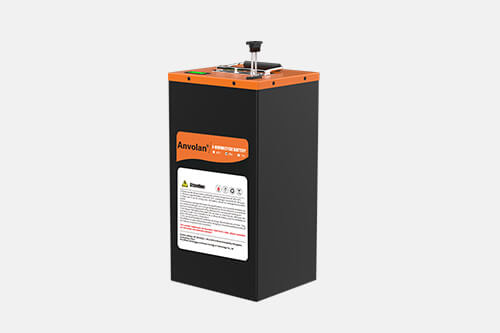
This 48V battery system adopts a standard 16-series LiFePO4 cell series architecture. Each single cell features a nominal voltage of 3.2V, and the series integrated structure forms a standard 51.2V operating voltage, which is fully compatible with all 48V-specification golf cart electronic control systems on the market and matches the original vehicle controllers, motors and charging logic. The cell adopts a stable material system with lithium iron phosphate as the positive electrode and graphite as the negative electrode. Energy conversion is completed through reversible de-embedding, migration and embedding of lithium ions between the positive and negative electrodes during charge and discharge cycles. The chemical reaction involves no severe phase transition or active material shedding, ensuring mild and stable operation. During charging, lithium ions detach from the positive electrode, migrate evenly through the electrolyte and embed into the negative electrode lattice, realizing the conversion and storage of electric energy into chemical energy. During discharging, lithium ions migrate reversibly to release electric charge and continuously output stable current for the motor, with extremely low loss in the whole process, fundamentally guaranteeing the sustainability and stability of power output.
Benefiting from the unique discharge operating characteristics of lithium iron phosphate cells, this 48V battery thoroughly solves the common voltage collapse defect of traditional lead-acid batteries. Traditional lead-acid batteries suffer from continuous and significant voltage attenuation with power consumption, resulting in weak starting power, speed drop during climbing and insufficient power under heavy loads. In contrast, LiFePO4 cells feature excellent platform voltage stabilization performance with a flat and stable voltage curve within the operating range. Within the conventional discharge depth, the output voltage remains constant at all times. Whether in uniform flat-road driving, continuous starting and acceleration, or long-distance climbing and heavy-load operation, the cells maintain efficient charge release efficiency, delivering linear and sufficient power output without power attenuation or voltage fluctuation throughout the operation, greatly improving the driving smoothness and load adaptability of golf carts.
In terms of cell dynamic balancing and safety operating mechanism, the complete battery set is equipped with a high-precision cell-level BMS management system. According to the series operating characteristics of 16 cells, it monitors the voltage, current and operating temperature of each single cell in real time. When multiple cells work in series, subtle individual differences easily cause cumulative voltage differences, leading to premature capacity decline and overcharge/over-discharge damage of partial cells. Adopting dynamic balance regulation technology, the BMS system corrects the charge capacity deviation of each cell in real time, synchronizing the charge and discharge rhythm of all single cells, eliminating hidden dangers of unbalanced series voltage differences, and ensuring every cell operates within the optimal working range. Meanwhile, relying on the high temperature resistance and thermal runaway resistance physical and chemical properties of LiFePO4 cells, combined with multiple temperature control protection functions, it effectively prevents cell damage caused by overcurrent, short circuit and high-temperature overload, significantly improving the overall operating stability and service life of the battery.
From the perspective of cell durability and operating life, LiFePO4 cells feature extremely low loss during cyclic charge and discharge, achieving more than 2000 cycles under deep discharge conditions, far exceeding the 300–500 cycle life of traditional lead-acid batteries. Supporting high-rate instantaneous discharge, the cells perfectly adapt to the peak current demand during golf cart starting and climbing with outstanding impact load resistance. Free of memory effect during long-term operation, the battery requires no regular deep discharge maintenance and supports random charging, adapting to the high-frequency and intermittent working scenarios of venue vehicles. Meanwhile, the cells deliver higher energy density and lighter weight under the same capacity, effectively reducing the overall vehicle weight, lowering motor energy consumption and further extending cruising range. With the stable electrochemical operating principle of cells, accurate series coordination mechanism and intelligent balance protection system, the 48V golf cart battery realizes the core advantages of stabilized voltage output, long durability and maintenance-free safety, completely replacing traditional lead-acid batteries and providing efficient, stable and long-lasting power energy storage support for venue transportation vehicles.
Be the first to receive our latest news, how-to user guides,
and exclusive deals! Subscribe now.

 Headquarter Address:10F, Building 25, N0. 179 Fengguan, Dongshen Road, Dongguan, Guangdong
 Factory Address:Building 3, Area D, Shengyang Science and Technology Industrial Park, East District of Suichuan County Industrial Park, Ji'an, Jiangxi
 Headquarter Telephone No.:+86 769 2366 8529
Factory Telephone No.:+86 796 6111618
 Contact Person:Kevin Chen
 Email Address:chen@xpower-world.com