Global layout
 +86 769 2366 8529




Time:2026-04-03 Views:93

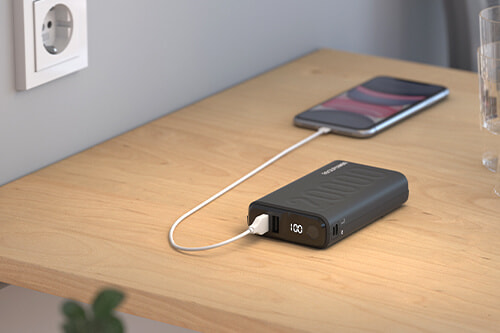
Shockproof and anti-drop design is essential for power banks, as accidental drops and impacts are common during daily use, and such incidents can damage internal components (e.g., battery cells, circuit boards) or the outer casing, leading to performance issues or safety hazards. The goal of shockproof and anti-drop design is to absorb and dissipate the impact force generated during a drop, protecting the internal components from damage and ensuring the power bank remains functional.
One of the key design features for shockproof and anti-drop protection is the use of shock-absorbing materials in the outer casing. Common materials include soft silicone, TPU (Thermoplastic Polyurethane), and EVA (Ethylene Vinyl Acetate), which have excellent elasticity and impact resistance. These materials are often used as a protective layer around the power bank’s core components, absorbing the impact force when the device is dropped. For example, silicone cases or TPU bumpers around the edges of the power bank can cushion the impact, reducing the force transmitted to the internal battery and circuit board. Some power banks also feature reinforced corners, as these are the most vulnerable areas during a drop—thicker or more elastic materials at the corners provide additional protection against impact.
Another important design feature is the internal structure of the power bank. Manufacturers use shock-absorbing buffers (such as foam or rubber pads) between the battery cells and the casing to reduce vibration and impact. The battery cells are also securely fixed in place using brackets or adhesive, preventing them from moving or colliding with other components during a drop. Additionally, the circuit board is often placed in a protective housing or covered with a shock-absorbing material to prevent damage from impact. Some high-end power banks also undergo rigorous drop testing to ensure their anti-drop capabilities—tests typically involve dropping the power bank from different heights (e.g., 1 meter, 1.5 meters) onto hard surfaces (such as concrete) multiple times, and then evaluating its functionality and structural integrity. Furthermore, the use of durable materials for the outer casing, such as aluminum alloy or reinforced plastic, enhances the power bank’s overall strength and resistance to impact. In summary, shockproof and anti-drop design features combine protective materials, internal buffering, and structural reinforcement to ensure power banks can withstand accidental drops and impacts, extending their lifespan and ensuring user safety.
Be the first to receive our latest news, how-to user guides,
and exclusive deals! Subscribe now.

 Headquarter Address:10F, Building 25, N0. 179 Fengguan, Dongshen Road, Dongguan, Guangdong
 Factory Address:Building 3, Area D, Shengyang Science and Technology Industrial Park, East District of Suichuan County Industrial Park, Ji'an, Jiangxi
 Headquarter Telephone No.:+86 769 2366 8529
Factory Telephone No.:+86 796 6111618
 Contact Person:Kevin Chen
 Email Address:chen@xpower-world.com